Performance athleisure can be easier to buy well when you treat the decision as a comparison exercise, not a hunt for the loudest sale message. Whether you need running layers, gym training clothes, yoga basics or versatile everyday pieces, the useful question is: which option meets the need at the lowest comparable total cost?
What Better Value Means for Performance Athleisure
AI-generated illustration — not a retailer product photo.
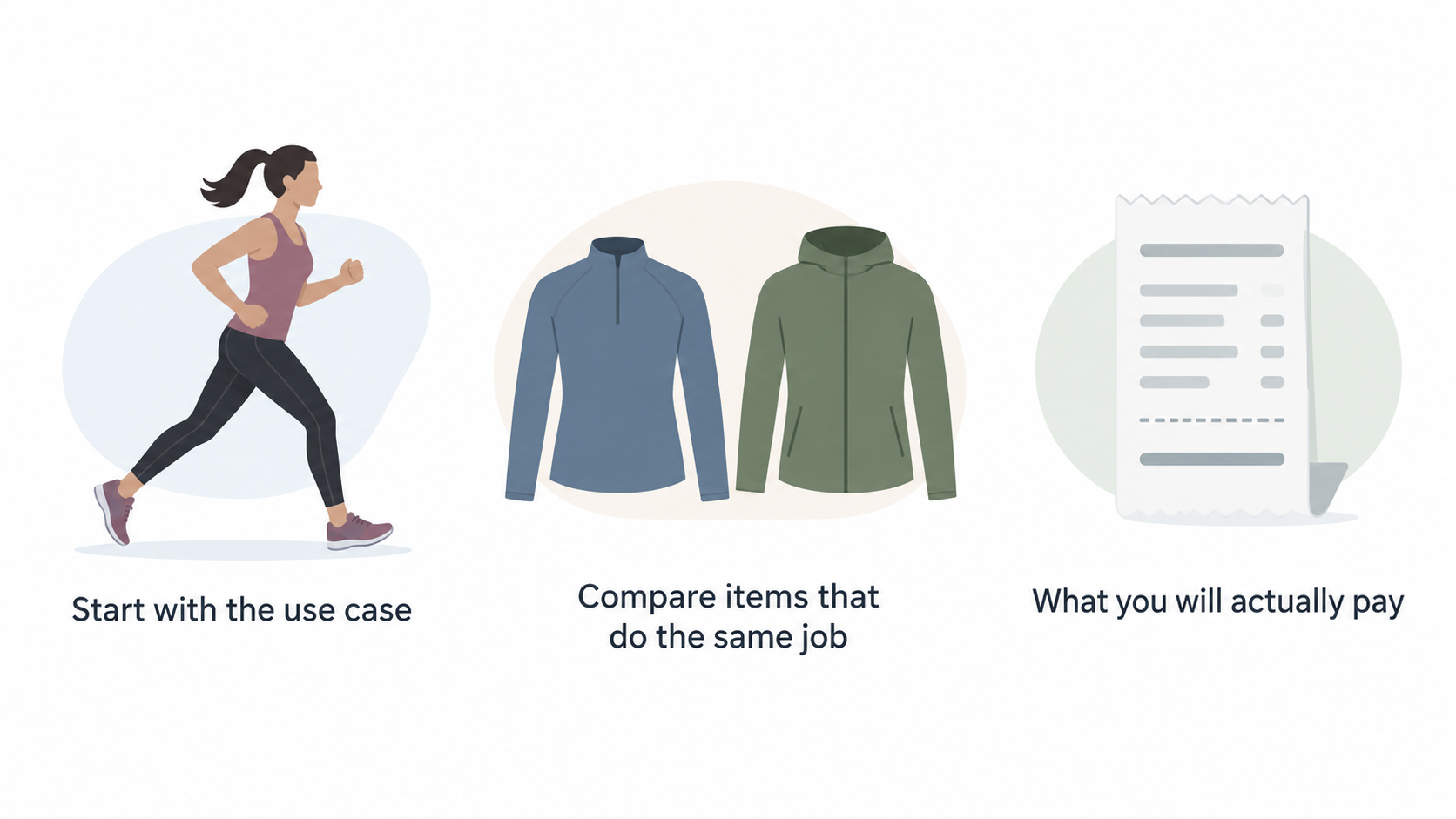
Better value is not automatically the lowest displayed price, the largest percentage-off badge or a universal “best time to buy”. It is the outcome of comparing items that can do the same job for you, then looking at what you will actually pay.
Start with the use case. A runner replacing worn tights may need secure pockets, weather suitability and enough comfort for regular sessions. Someone building a gym wardrobe may prioritise movement, wash frequency and pieces that work together. For yoga or everyday wear, fit, coverage and how often an item will realistically be used may matter more than a promotional label.
That approach keeps the comparison grounded. A lower-priced item can still be a poor choice if it does not meet the intended use, while a higher displayed price may be the more workable option if the final payable price, delivery arrangement and product requirements line up. UK price-transparency guidance says consumers need clear, complete and accurate price information in order to make informed decisions and compare competing products. CMA price-transparency summary
Use “better value” as a personal comparison rule: suitable item, like-for-like alternative, complete price and terms you can accept. It is a more reliable frame than trying to predict whether a particular sale period will produce a saving.
Build a Comparable Needs-Led Basket
AI-generated illustration — not a retailer product photo.
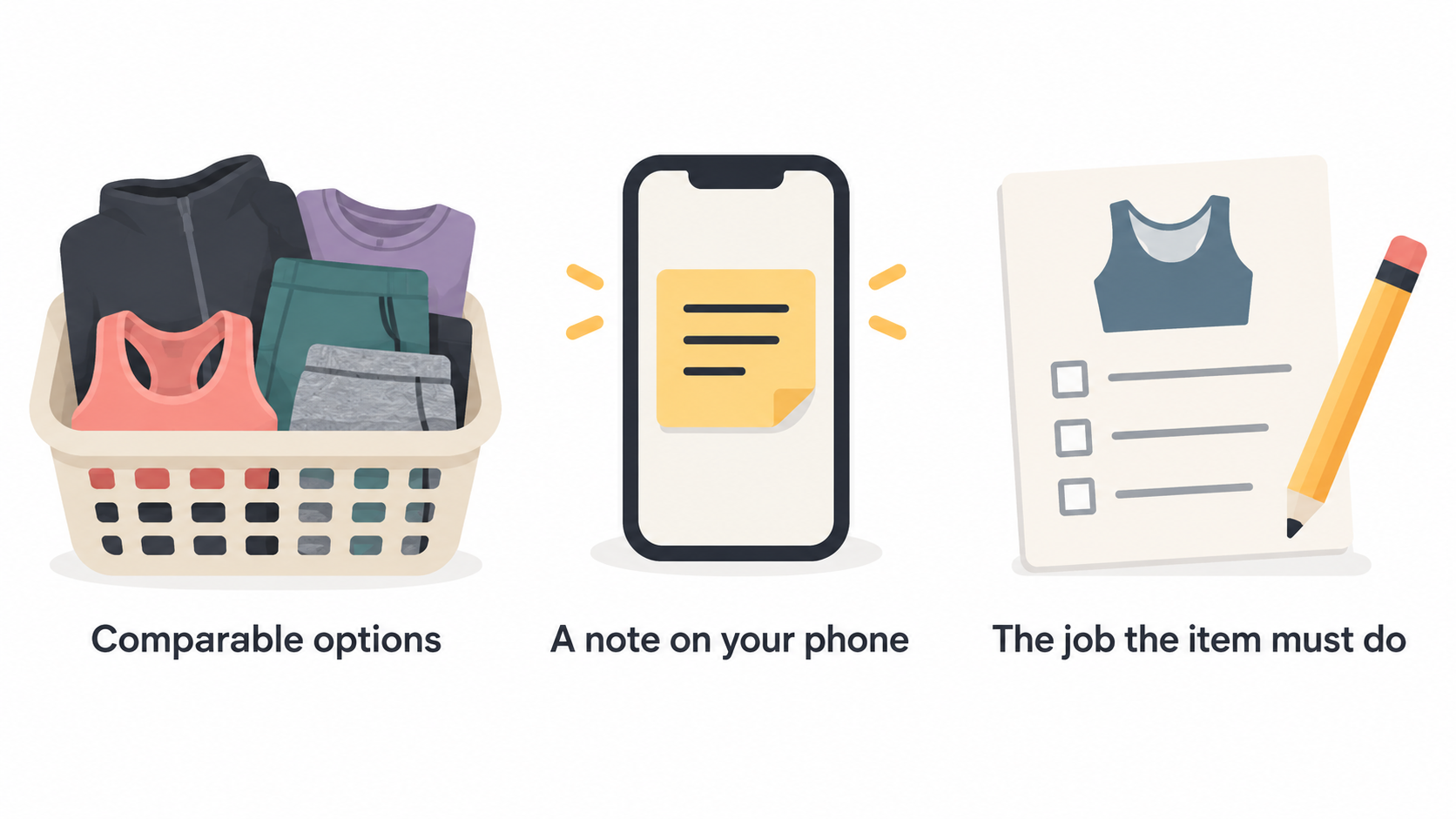
Before checking prices, make a small basket of genuinely comparable options. This does not need to be a formal spreadsheet, although a note on your phone can help. The important part is deciding what you are comparing before a promotion nudges you towards an extra item or a less suitable alternative.
For each planned purchase, write down the job the item must do. A useful running list might include shorts, a technical top, a warmer layer and socks; a gym list might include tops, bottoms and a layer for travelling to and from training. If you are shopping for mixed use, separate “training essential” from “nice to have”. That makes it easier to delay a discretionary purchase without delaying a replacement you genuinely need.
Then set a few minimum requirements. They can be practical rather than technical:
- intended activity and typical weather or setting;
- fit, coverage and freedom of movement;
- whether you need pockets, a particular length or easy layering;
- how often you expect to wear and wash the item;
- colour or styling constraints only where they affect how often you will use it;
- the maximum complete price you are prepared to pay.
Keep the basket narrow enough to compare. A black running legging with a secure pocket is not necessarily comparable with a lounge legging, even if both appear under the same “activewear” filter. Likewise, a discounted multipack is not automatically a substitute for one item that solves a specific replacement need.
It can also help to identify one acceptable alternative for each essential item. That alternative may be a similar product, a different size or colour that still meets the requirement, or a retailer with a different delivery and returns proposition. The point is not to rank retailers in advance. It is to avoid deciding from a single page, a countdown banner or a percentage-off message.
Once the basket is defined, you can compare options fairly. If an offer only makes sense because it adds products you did not plan to buy, treat it as a new purchase decision rather than proof that your original basket is better value.
Compare the Total Price Rather Than the Headline Price
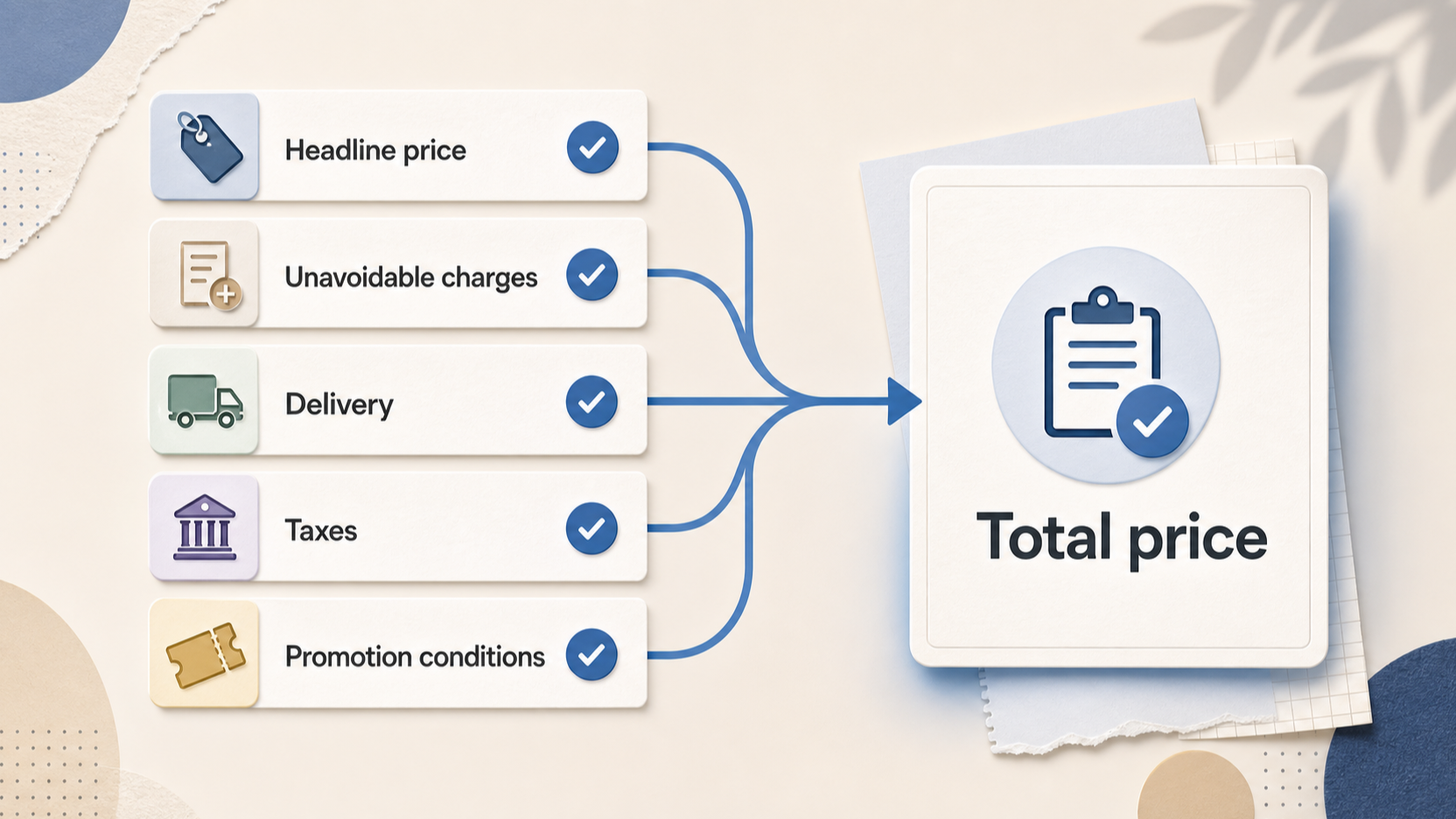
The displayed product amount is only the starting point. For each comparable basket, look for the total you will have to pay to complete the purchase. Include unavoidable charges, taxes or fees, and any delivery charge that applies to the order you actually intend to place.
The CMA’s price-transparency summary says traders must provide total prices up front and that prices should be clear, complete and accurate. It also says it is illegal to hide additional fees, taxes or other charges that customers have to pay later in the purchase process, sometimes described as drip pricing. That guidance helps explain why complete price information matters for shopping around; it does not tell you that a particular activewear item is good value. CMA price-transparency summary
A practical total-price check is:
- Record the price of the exact item, size and colour you would buy.
- Add every unavoidable charge shown for that purchase.
- Check whether delivery changes with the basket total, delivery option or membership status.
- Confirm whether a promotion requires you to add another item or spend more.
- Compare the final payable total with the alternative, rather than comparing only product-page prices.
If a charge is unclear until late in checkout, pause the comparison rather than filling in the gap with an assumption. The lack of a clear total can prevent a meaningful like-for-like decision. It may raise a price-presentation concern, but it is not evidence by itself that the product, retailer or offer is poor value for every shopper.
Also separate unavoidable costs from optional choices. A faster delivery option you freely select may be useful, but it is not the same kind of comparison input as a charge every buyer must pay. Record it so you can see the whole cost of your chosen order, then decide whether the added convenience is worth it for your circumstances.
Use Planned Purchase Windows Instead of Chasing Sale Labels
A planned purchase window is a period you set for yourself because a need is approaching, your budget is available or you have enough time to compare alternatives. It is not a prediction that a retailer will discount a particular product at a particular time.
Begin with replacement pressure. If a core running or gym item is wearing out, identify it early enough that you can shop without urgency. Set a target complete price, list the minimum requirements and keep one comparable alternative. You can then check prices over a period that suits your budget instead of buying immediately because a sale label creates pressure.
For non-urgent purchases, use a simple waiting rule. Save the exact item and the closest acceptable alternative, then return to the comparison when you have the funds and still have a clear reason to buy. If the item remains suitable and its complete price is within your target, you have a decision basis. If not, waiting can be reasonable—but not because a future sale is guaranteed.
A few questions can keep the window practical:
- Is this replacing an item that no longer works for its intended activity?
- Would I buy this exact item without adding unrelated products to unlock an offer?
- Do I know the maximum total I am willing to pay, including applicable delivery?
- Is there a like-for-like alternative I can compare before checkout?
- Will a delay create a genuine problem, such as leaving me without suitable training clothing?
This approach is useful around any promotional period because it protects the original need. A percentage-off message can be relevant, but it should enter the comparison after you know what you need and what the complete basket costs.
The CMA guidance is particularly relevant here: clear and complete pricing supports consumers in making informed decisions and comparing competing products. Use that transparency to compare, not as a reason to assume that a label such as “sale”, “limited time” or “was” proves a real saving. CMA price-transparency summary
Timing alone does not establish value. A planned purchase can still be unsuitable, and an apparent discount can still lead to a higher total or an unnecessary basket. The final decision should remain anchored to fit for purpose and the complete payable price.
Check Promotion Terms Before Treating Them as Savings
AI-generated generic editorial illustration — not a retailer product photo and does not depict the reviewed product or service. Support the practical routine for checking whether a promotion produces a real saving.
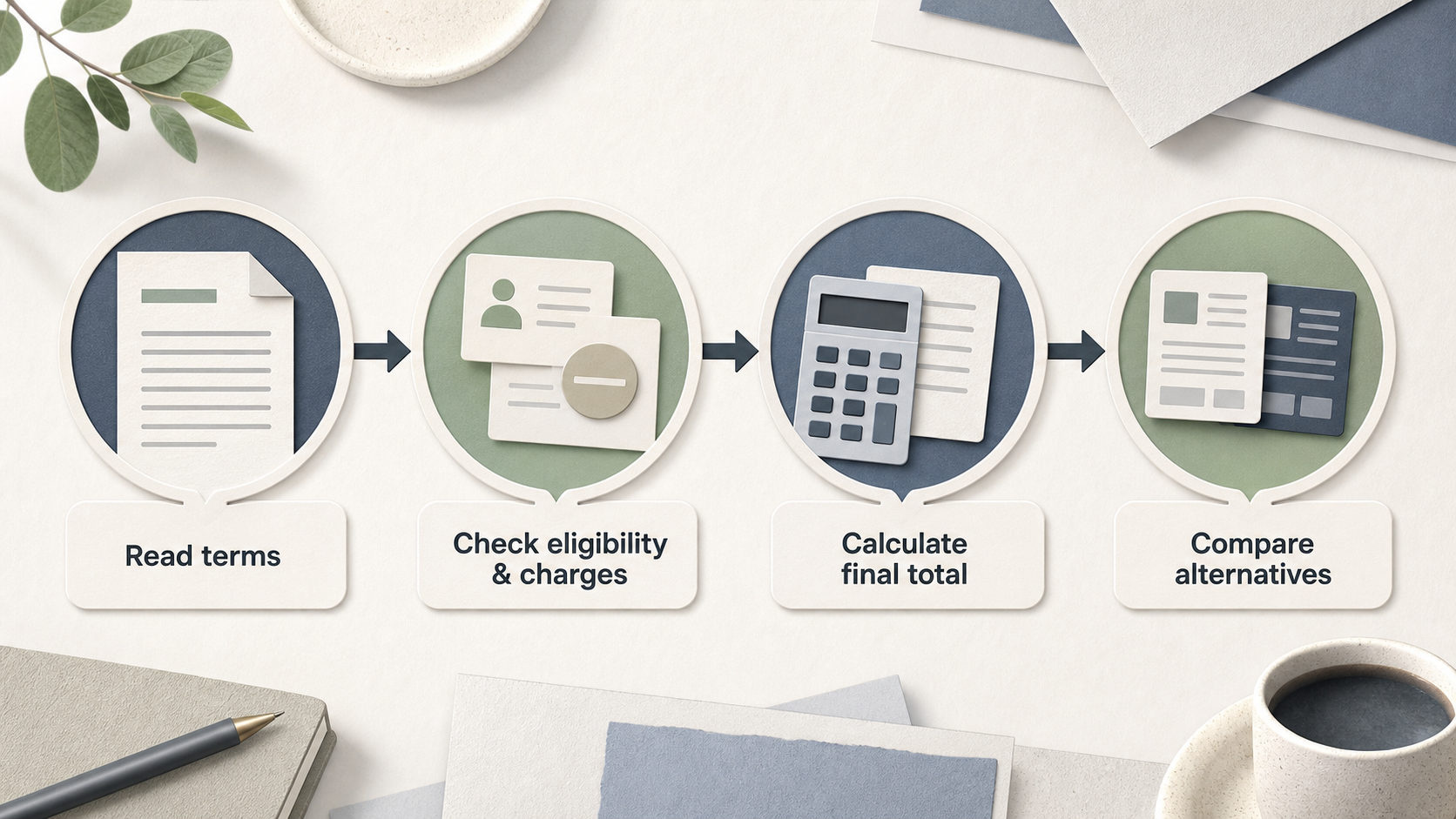 A promotion becomes useful only when it reduces the complete cost of the basket you actually want. Read the terms before treating the headline percentage or offer wording as a saving.
Start by matching the promotion to your planned basket. Check whether the exact item, size and colour are eligible; whether there is a minimum spend; whether selected lines are excluded; and whether the offer requires a code, a membership, a subscription or another condition. Then calculate the final amount with the conditions applied.
Use this short routine:
- Read the promotion wording and any linked terms.
- Confirm that the planned item qualifies.
- Identify spending thresholds, exclusions and eligibility conditions.
- Add unavoidable delivery, taxes or other charges to the resulting basket.
- Compare that final payable total with your saved like-for-like alternative.
For example, an offer that requires extra items to reach a threshold may still be worth considering if those additional items were already in your needs-led basket. If they were not, compare the total with buying only the item you need elsewhere. The larger basket is not automatically a saving simply because the discount number is larger.
The CMA’s consumer-protection guidance collection includes guidance on displaying prices for goods and services, while the price-transparency summary emphasises complete and accurate prices, including charges consumers cannot avoid. These sources support checking the full payable amount and the conditions that affect it. They do not validate a retailer’s individual promotion or guarantee that an offer is the best available choice. CMA consumer-protection guidance CMA price-transparency summary
If the terms are hard to understand, the total cannot be confirmed, or the offer changes the basket beyond your original need, it is reasonable to leave it out of the comparison. A clear “no” is often more useful than trying to force a promotion into a purchase plan.
Compare Retailer and Product Alternatives Like for Like
Once you know the final cost of one option, compare it with an alternative that performs the same role. Do not compare a highly specific running item with a casual substitute merely because one is cheaper. Equally, do not assume the same product is the better deal at the retailer with the lowest initial display price.
Make the comparison line by line:
- exact or equivalent item and its required features;
- size, colour or availability that you can genuinely use;
- final payable total for the intended basket;
- delivery timing and applicable delivery charge;
- returns information and any cost or condition that could matter to you;
- whether the alternative needs an additional membership, code or threshold;
- whether buying now solves the identified need.
Availability deserves attention. An apparently lower price is not a workable comparison if the required size is unavailable or if the item is only eligible for a different set of terms. Note that fact rather than quietly treating it as an equal alternative.
Returns can also change the decision after the displayed price has caught your attention. Read the retailer’s current terms for the option you are considering, especially if fit is uncertain or you are ordering multiple sizes. Do not assume that all retailers handle return costs, timings or exclusions in the same way.
The CMA summary explains that complete and accurate prices help consumers shop around and compare competing products. Apply that principle to the whole purchase: product suitability, unavoidable charges, delivery and terms. CMA price-transparency summary
A brief written note can prevent rushed decisions: “Option A meets the need and totals £X; Option B is equivalent and totals £Y under these terms.” The better choice is the one that remains suitable and acceptable after that like-for-like check, not necessarily the one with the boldest promotion.
Frequently Asked Questions
Should I wait for a sale before replacing running or gym clothing?
Not necessarily. If an essential item needs replacing, define the required features, set a target complete price and compare at least one suitable alternative. Waiting can make sense when the need is not urgent, but a future sale is not evidence that the final price will be better. Buy when the item meets the need and the complete payable price is acceptable to you.
Does a percentage-off promotion always mean I am paying less overall?
No. Check whether the exact item qualifies, whether the offer requires a threshold or extra products, and whether delivery or other unavoidable charges change the final total. A percentage-off message is an input to the calculation, not the calculation itself.
Which extra costs should I check before buying performance athleisure online?
Check all unavoidable charges that apply to the order you plan to place, including delivery where applicable, as well as taxes or fees shown for the purchase. The CMA says total prices should be provided up front and that unavoidable charges should not be hidden until later in the process. CMA price-transparency summary
How can I compare two similar activewear items fairly?
Compare products that can perform the same job for you. Record the exact item or equivalent, the requirements it meets, availability in your usable size, the final payable total, delivery conditions and relevant returns terms. If one item needs a different basket, membership or compromise on the original requirement, note that difference before deciding.
Transparent pricing makes comparison easier, but it cannot decide what is good value for every shopper. The strongest routine is still needs first, then like-for-like options, complete prices and promotion terms.
Related reading
- Best performance athleisure: evidence-led top choices
- How to choose performance athleisure for your needs
- How performance athleisure should fit, feel, and perform
- How to identify genuine performance athleisure deals
Editorial information: About our editorial team · Read our editorial policy · Read our affiliate disclosure.